Brazil’s Betting Boom: How a $5.5 Billion Tax Play Is Reshaping a Nation’s Finances
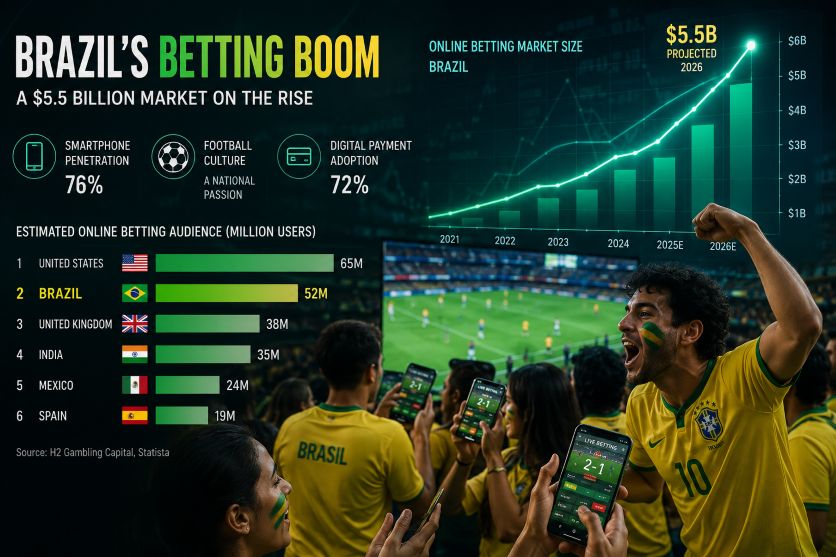
Brazil’s newly regulated betting industry could generate nearly BRL 30 billion in annual tax revenue, a figure that has quickly turned online gambling into one of the country’s most closely watched economic experiments. Estimates from Itaú, XP Investimentos, and market analysts covering Brazil’s gaming sector suggest the legal market may reach more than USD 5.5 billion yearly as regulation expands and operators move into licensed channels.
Brazil gambling tax revenue projections have become central to national policy discussions after lawmakers formally approved fixed-odds betting regulation through Law No. 14,790/2023. Research published by Brazil’s Ministry of Finance indicates the government expects billions in annual collections from licensing fees, operator taxes, and player taxation as the market matures over the next several years.
That financial potential explains why Brazil moved aggressively to regulate a market that had operated in legal uncertainty for years. The government now views sports betting and online gaming as more than entertainment businesses. Officials increasingly frame the industry as a fiscal tool capable of supporting public security, social programs, and federal revenue targets during a period of economic pressure.
From Gray Market to National Industry
Brazil spent years watching offshore sportsbooks operate freely without meaningful local oversight. Betting activity surged after the country legalized fixed-odds sports wagering in 2018, yet detailed regulations lagged behind. International operators continued serving Brazilian customers while paying little direct tax into the domestic economy.
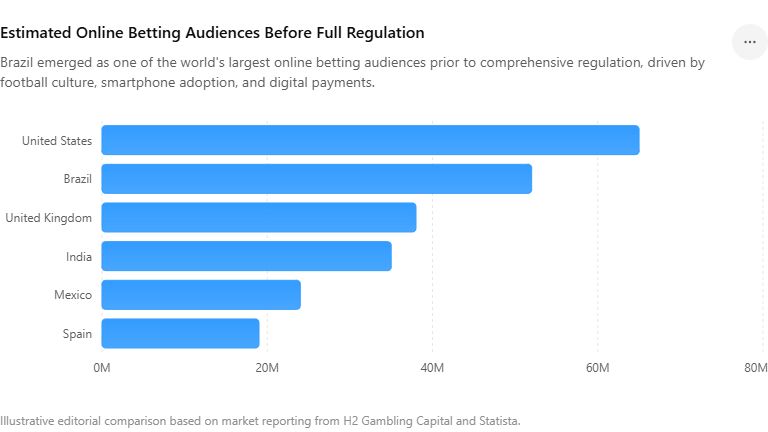
Data from H2 Gambling Capital and Statista shows Brazil already ranked among the world’s largest online betting audiences before comprehensive regulation arrived. Football culture, widespread smartphone access, and growing digital payment adoption helped drive rapid expansion.
Federal authorities eventually concluded the country was losing substantial taxable revenue to offshore operators. That realization accelerated the push toward licensing systems, compliance rules, advertising standards, and formal tax collection.
Regulation arrived in stages. Brazil introduced licensing requirements for operators, established oversight responsibilities under the Ministry of Finance, and implemented rules covering advertising, anti-money laundering controls, and consumer protections. The government also introduced technical standards designed to separate legal operators from illegal platforms.
Industry analysts note that the transition mirrors developments previously seen across Latin America. Colombia, Argentina, and Peru each attempted versions of regulated online gambling frameworks over the past decade. Brazil’s market, however, stands apart because of its population size and enormous sports audience.
The Tax Structure Driving the Boom
Brazil’s betting framework relies on layered taxation rather than a single flat charge. Licensed operators must pay authorization fees while also contributing taxes based on gross gaming revenue. Player winnings above specific thresholds face additional taxation.
The government initially structured operator taxation at 13% of gross gaming revenue. Policymakers later discussed increasing portions of the effective rate closer to 15% as the regulatory framework expanded and fiscal expectations grew.
Officials argue the structure balances two competing goals. Authorities want to maximize public revenue while keeping the legal market competitive enough to attract players away from offshore platforms.
Brazil’s Ministry of Finance has repeatedly emphasized that tax collection depends on channeling consumers into regulated environments. Excessive tax burdens could push operators or customers back into illegal markets, reducing overall compliance and shrinking projected public income.
Research from KPMG and regional gaming consultants suggests moderate tax rates often produce stronger long-term returns than highly aggressive models. Lower friction encourages licensed participation, which improves reporting transparency and enforcement capabilities.
That balance remains delicate. Brazil’s betting industry still faces substantial compliance costs tied to cybersecurity, responsible gambling systems, fraud monitoring, and local operational requirements. Smaller operators may struggle to absorb those expenses if taxation rises too quickly.
Where the Money Is Expected to Go
Government planners have linked betting revenue to several public spending priorities. Portions of the collected taxes are expected to support public security initiatives, education programs, tourism development, and social security obligations.
Brazilian lawmakers specifically highlighted the possibility of using gaming revenue to strengthen policing and anti-crime infrastructure. Authorities argue regulated betting generates traceable financial activity, which may improve oversight compared to unregulated offshore systems.
Social security funding has also become a recurring political talking point. Brazil continues facing long-term pension and fiscal sustainability concerns as demographic pressures grow. Additional tax streams from regulated gambling are viewed by some policymakers as supplemental support rather than a complete solution.
Data from Brazil’s Federal Revenue Service indicates policymakers increasingly favor targeted consumption-based revenue streams as traditional budget pressures intensify. Betting taxation fits within that broader fiscal strategy.
Critics, however, warn that governments can become overly dependent on gambling-related income. Public policy researchers note that betting markets remain sensitive to economic slowdowns, regulatory disputes, and consumer confidence trends.
The Illegal Market Still Threatens the System
Brazil’s legal market may be growing quickly, but illegal operators remain a major concern. Industry experts estimate that a significant share of betting activity still occurs through unlicensed platforms offering fewer restrictions and potentially more aggressive promotions.
The International Betting Integrity Association and regional compliance groups have warned that enforcement will determine whether Brazil’s regulatory system succeeds financially. Tax collection projections depend heavily on the government’s ability to migrate users into licensed channels.
Illegal operators often avoid responsible gambling protections, identity verification systems, and financial monitoring requirements. That creates pricing advantages because unlicensed companies avoid many compliance expenses faced by regulated businesses.
Authorities have responded by expanding payment monitoring and blocking unauthorized operators. Regulators are also increasing scrutiny over advertising practices and sponsorship arrangements connected to unlicensed sportsbooks.
Still, enforcement remains difficult in digital markets where offshore websites can quickly change domains or payment methods. Analysts note that consumer education and competitive legal offerings may ultimately matter as much as punitive enforcement actions.
Colombia’s Warning for Brazil
Brazilian policymakers continue studying international examples while refining their framework. Colombia frequently appears in those discussions because it became one of Latin America’s earliest regulated online betting markets.
Colombia initially received praise for creating a stable licensing structure that attracted international operators. Over time, however, concerns emerged about taxation levels and market sustainability.
Industry groups referencing data from Fecoljuegos, Colombia’s gaming federation, reported revenue declines approaching 30% in certain segments after heavier fiscal pressure and operational costs affected the market. Analysts argued that higher burdens weakened legal competitiveness against offshore alternatives.
Brazilian regulators appear aware of that risk. Several finance officials have publicly emphasized the importance of maintaining a commercially viable licensed sector rather than pursuing maximum short-term taxation.
Research shows successful regulated markets generally depend on three factors: moderate taxation, effective enforcement, and consumer trust in legal platforms. Weakness in any one area can undermine the entire system.
Conclusion
Brazil’s betting market has evolved from a loosely regulated gray economy into one of the world’s most significant gambling policy experiments. The projected BRL 30 billion annual revenue figure has transformed the conversation from entertainment regulation into national fiscal strategy.
The country’s success will likely depend less on headline revenue projections and more on execution. Regulators must balance taxation with market competitiveness, strengthen enforcement against illegal operators, and maintain public confidence that betting-related income genuinely supports public priorities.
Lessons from Colombia and other Latin American markets suggest aggressive taxation alone does not guarantee sustainable public revenue. Stable regulation, predictable compliance structures, and realistic fiscal expectations may prove more important over time.
Brazil now sits at a critical moment where gambling taxation, digital regulation, and economic policy intersect. The outcome could influence how other emerging markets approach online betting regulation during the next decade.